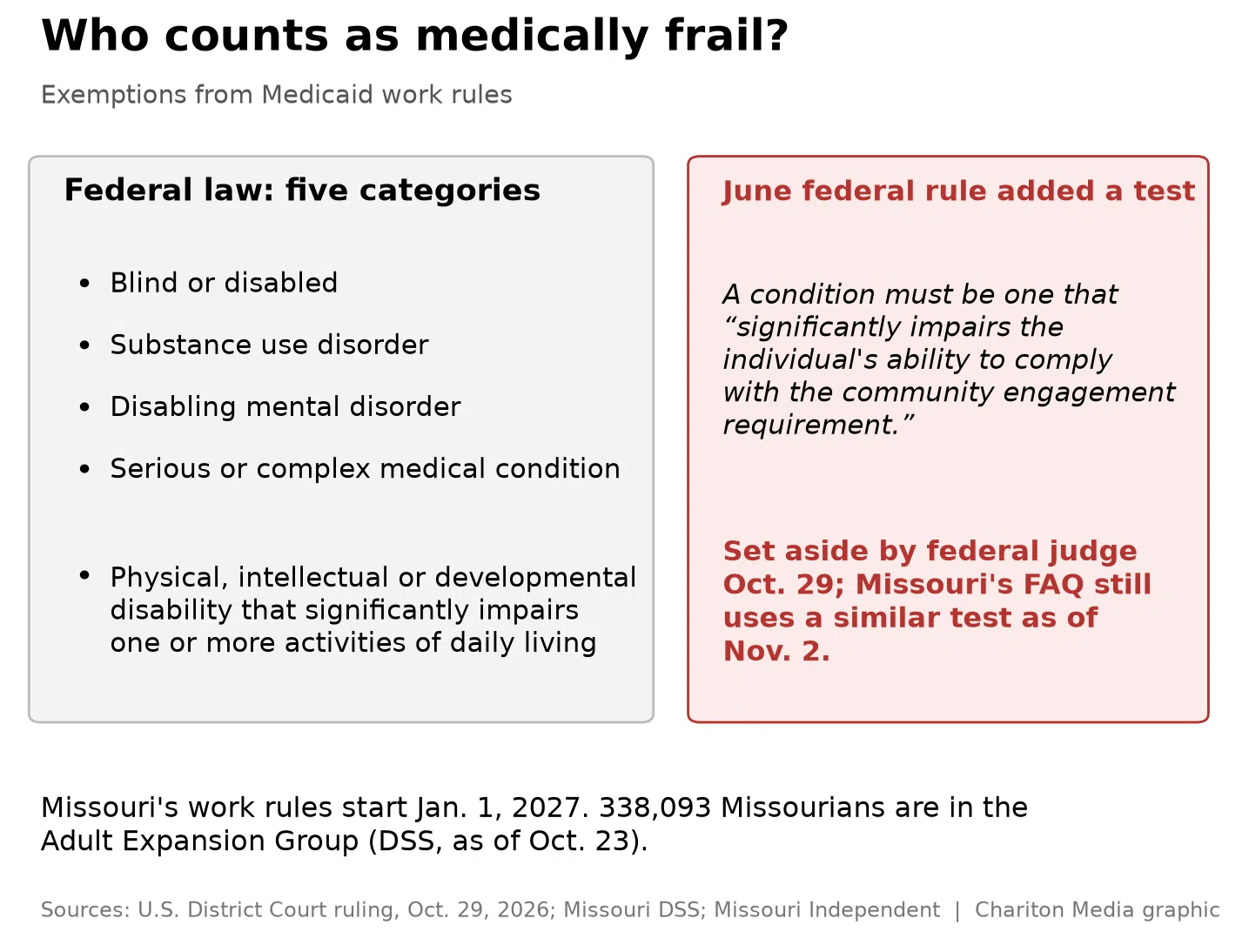
A federal judge last week struck language from a federal Medicaid rule that would have required seriously ill and disabled enrollees to show their condition limits their ability to work to be excused from new work requirements. The ruling applies nationwide, according to KFF, the health policy research group. But Missouri's own guidance for the rules, which start Jan. 1, still carried similar language as of Nov. 2.
U.S. District Judge Richard Stearns in Boston ruled Oct. 29 in a case brought by 25 states and the District of Columbia, Stateline reported. Missouri is not among them, according to the ruling's list of plaintiffs. The judge found "vacatur of the offending language is warranted," setting aside the rule's added test. The judge also granted the states that sued the permanent injunction they requested and a six-month stay of enforcement on medical frailty decisions.
The added test came from the federal rule issued in June. Missouri's work requirements begin Jan. 1, according to the Missouri Department of Social Services.
The rules apply to adults ages 19 through 64 in MO HealthNet's Adult Expansion Group, according to the department. The state counted 338,093 people in that group as of Oct. 23, the Macon Chronicle reported Oct. 28.
Macon County has no separate published count of expansion enrollees. About 1,115 county residents ages 19 to 64, or 14 percent of that age group, had Medicaid or other means-tested public coverage, according to Census Bureau estimates for 2020 through 2024. Statewide, the share was 11 percent. The Census figure includes every working-age adult on Medicaid, so it likely overstates how many local people the work rules will reach.
To meet the rules, enrollees must work, go to school, or volunteer at least 80 hours in a month, or earn at least the federal minimum wage times 80 hours, according to the department. Under current state policy, enrollees already covered must meet that bar in at least one month since their last renewal. People who are medically frail do not have to meet the rules once the Family Support Division confirms it. The department's published guidance describes that group as people who are "medically frail or have special medical needs that greatly limit your ability to meet the requirements."
The same guidance says a diagnosis alone does not excuse anyone, and that the division must confirm a condition "greatly limits your ability to work, study, train, volunteer, or take part in a work program." That is close to the work test Stearns struck down. As of Nov. 2, the department had not said publicly whether it will change that test after the ruling; its FAQ still carried the language. Federal law lists five categories of medically frail people, including those who are blind or disabled, have a substance use disorder, a disabling mental disorder, or a serious or complex medical condition. The June rule added a requirement that the person's condition "significantly impairs the individual's ability to comply with the community engagement requirement," according to the ruling.
How Missouri will decide who is medically frail has shifted. Department media director Baylee Watts said in September that the state "has not yet finalized whether Missouri will use self-attestation during 2027 or what specific screening methodology it will adopt," the Missouri Independent reported.
Since then, the Family Support Division has said that for 2027 the state will accept self-attestations for people in the expansion group who are not automatically excluded through other exemptions, and that it will not pursue the optional short-term hardship exceptions allowed under the federal law, according to a Missouri Hospital Association post on the division's new FAQs.
Two parts of the federal rule that Stearns upheld apply in every state, including Missouri. States must reject proof of medical frailty more than a year old, and a person may declare on their own that they qualify only once per enrollment period, Stateline reported. The once-per-enrollment limit starts in 2028, according to Georgetown University's Center for Children and Families.
Stearns wrote that the states' objections to both limits were "unconvincing" and that "the Government provided a non-frivolous rationale for adopting each provision."
For the states that sued, the judge found the narrower definition could cause real harm. Enforcing "an unlawful definition of 'medically frail' may lead to the disenrollment of otherwise eligible vulnerable individuals relying on Medicaid coverage for continuity of care," Stearns wrote, and "the States (and public) face potential for great hardship in the absence of an injunction."
A separate lawsuit filed in September in federal court in Maryland challenges the same rule, and a Missouri Medicaid enrollee is among the plaintiffs, the Missouri Independent reported.
Willie Underwood, president of the American Medical Association, called the Boston ruling "a victory for patients," Stateline reported.
The department says enrollees do not need to respond to its informational outreach notices. It advises people to keep their address current with the Family Support Division, read every letter, and keep records, but not to send proof until asked. In Macon County, documents can be dropped off at the Family Support Division's Macon Resource Center, 1716-B Prospect Drive.
Portions of this story were drawn from reporting by Shalina Chatlani of Stateline, published Oct. 29, 2026. Read the original: https://stateline.org/2026/10/29/medically-frail-medicaid-enrollees-wont-have-to-prove-they-cant-work-to-keep-coverage/. Missouri details, local figures, and other additions are the Macon Chronicle's.