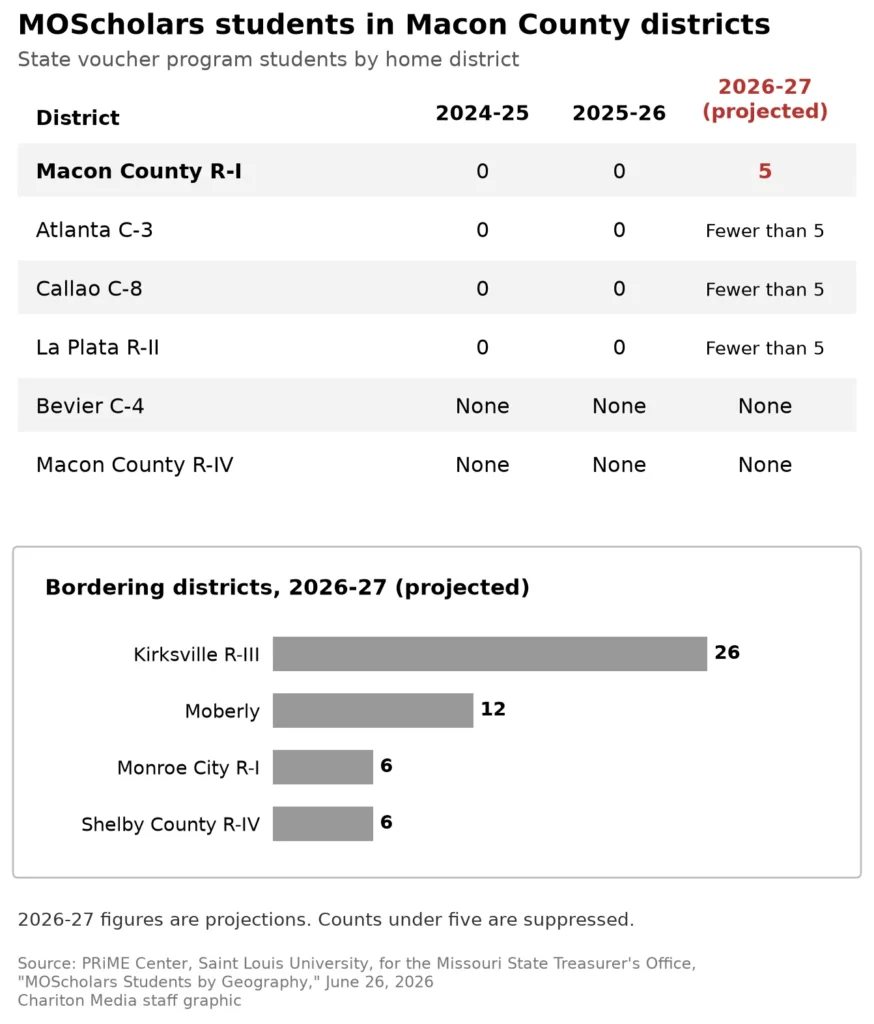
Missouri’s MOScholars voucher program had no participants living in any Macon County school district in its 2024-25 or 2025-26 school years. This year, a report prepared for the state projects that is changing.
A geography report prepared for the Missouri State Treasurer’s Office projects five MOScholars students living in the Macon County R-I School District in Macon for the 2026-27 school year. It projects fewer than five each in the Atlanta C-3, Callao C-8, and La Plata R-II districts. The report does not list Bevier C-4 or Macon County R-IV in New Cambria at all, meaning no participants were counted or projected there.
The report, "MOScholars Students by Geography," is dated June 26 and was prepared by the PRiME Center at Saint Louis University. Researchers took student addresses from the program’s application records and mapped them to public school district boundaries. The 2026-27 figures are projections based on applications submitted before April 30, and the report notes that actual participation may differ because not all applicants may be accepted. Counts under five are suppressed, so the report shows only "<5" for small districts.
MOScholars pays for private school tuition and other education costs through education savings accounts. Students counted in a public school district live inside its boundaries.
The State Treasurer’s Office says MOScholars "does not reduce the funding received by a student’s resident school district." The scholarships are paid for with private donations to approved nonprofits, and donors get a state tax credit for 100 percent of the gift. The money comes out of state general revenue, not school aid. The state’s fiscal note on SB 727 put the extra revenue loss at about $55 million for fiscal 2026. One indirect hit is possible: state aid is based on attendance, so a district loses some aid when a student leaves for private school. With Macon R-1 projected at only five students, that effect is small.
Macon County’s earlier zero is not a surprise. During the program’s first three years, only students living in a charter county or a city of 30,000 or more could take part. Senate Bill 727, passed in 2024, removed that restriction. The PRiME researchers wrote that the areas with the highest percentage growth "were geographic locations that were previously ineligible for participation."
Bordering counties show the same pattern, with a few larger numbers. Kirksville R-III in Adair County went from zero in 2024-25 to fewer than five in 2025-26 and a projected 26 this year. Moberly in Randolph County is projected at 12, after zero in each of the past two years. Monroe City R-I had seven participants in 2025-26 and is projected at six. Shelby County R-IV is projected at six.
Projections of fewer than five appear for Adair County R-I and R-II, Northeast Randolph County R-IV, Westran R-I, Keytesville R-III, Linn County R-I, Marceline R-V, and Meadville R-IV. No Knox County district is listed. Neither are North Shelby, Paris, Madison, Higbee, Renick, Brunswick, Salisbury, Northwestern, Brookfield, or Bucklin.
Statewide, the number of public school districts with at least one participant grew from 75 of 516 in 2024-25 to 242 in 2025-26.
Most participants still live in metropolitan areas. More than 80 percent were in the St. Louis and Kansas City areas in each of the past two years, and the report projects the same for this year. But participation in town and rural areas grew 7,800 percent from 2024-25 to 2025-26, the report found, compared with 135 percent in cities and suburbs.
The program’s first report on how its students perform came out last week. Released Oct. 28 by Treasurer Vivek Malek’s office, it found that MOScholars students scored near the national average, the Missouri Independent reported. Average scores ranged from the 46th to the 51st national percentile in English language arts and from the 47th to the 49th in math, according to the Independent.
The results come with limits. Researchers could validate test results for only 77 percent of students in testing grades, the Independent reported. They identified 27 different test types, eight of which were not nationally norm-referenced. The report lacks family income data that state law requires, and it does not cover 2025-26, the year the program more than doubled, according to the Independent.
The findings do not show whether the program improved student outcomes or whether its students outperform public school students, Annelise Hanshaw of the Missouri Independent reported.
"This testing sample is going to massively grow. So make it at what you will, but this is the baseline that we will see the future of the program being judged against," PRiME Executive Director Collin Hitt said, according to the Independent.
Malek praised the results in a news release, the Independent reported. "Behind these numbers are families who have been given the opportunity to find the right educational fit for their children, including students with special needs who deserve every opportunity to succeed," Malek said.
State Sen. Doug Beck, a Democrat from Affton, criticized the report in a statement to the Independent. "This report is incomplete, admits the Treasurer isn’t following the law, was outsourced to a third party and doesn’t answer key questions," Beck said.
MOScholars program specialist Meghan Rackers addressed data collection in an emailed statement to the Independent. "The program now has the proper policies, procedures and partners in place to work with educational assistance organizations to collect the assessment scores in a timely and accurate manner," Rackers wrote.
A parent survey the office released with the performance report found 99 percent of respondents satisfied with the program, according to the Independent.
Families can find program information at the Treasurer’s Office website, treasurer.mo.gov.