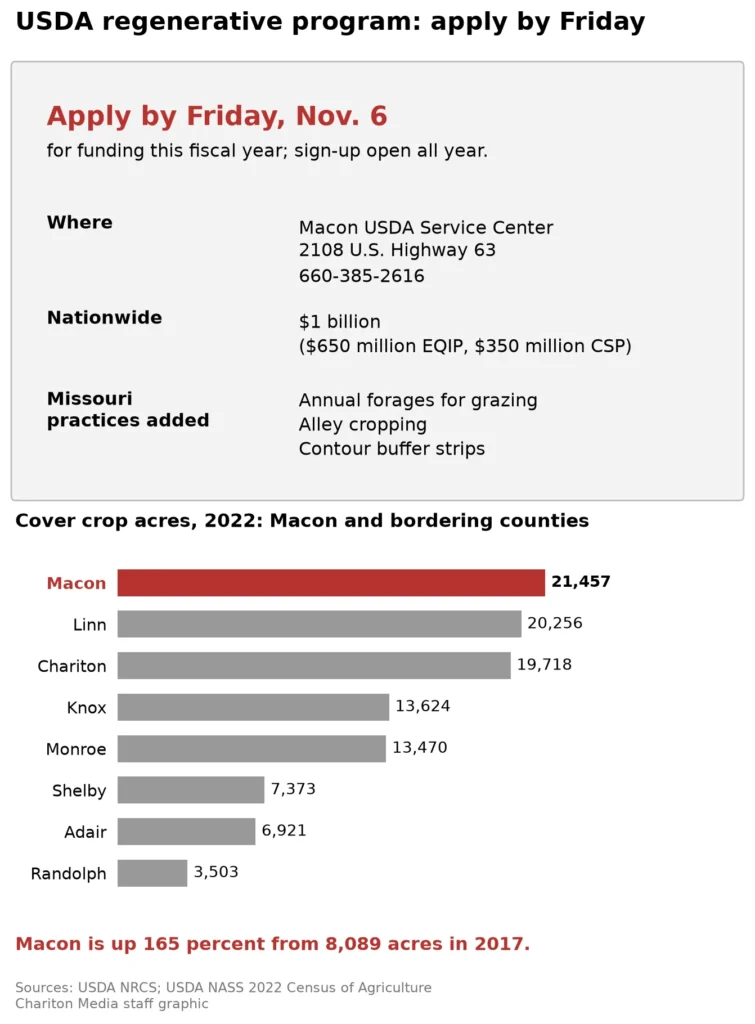
Macon County farmers and ranchers who want funding this fiscal year from a federal regenerative agriculture program should apply by Friday, Nov. 6.
The U.S. Department of Agriculture’s Natural Resources Conservation Service in Missouri announced Oct. 30 that it has added three practices to its Regenerative Pilot Program for the 2027 fiscal year. Producers can sign up at any time, but Missouri applicants who want funding in the current fiscal year should apply by Nov. 6, the agency said.
Applications are taken at local NRCS service centers. Macon County’s is the USDA Service Center at 2108 U.S. Highway 63 in Macon, 660-385-2616.
USDA raised the program’s financial assistance from $700 million to $1 billion for its second year, according to a Sept. 29 national release. Of that, $650 million comes through the Environmental Quality Incentives Program and $350 million through the Conservation Stewardship Program. A single application covers both, and producers can bundle several practices into one request. The program is designed for both beginning and advanced producers, according to the release.
The three practices added in Missouri are annual forages for grazing systems, alley cropping, and contour buffer strips. They add to the program’s core practices offered nationwide. The state’s technical advisory committee recommended the additions under a change that lets states tailor the list to local conditions, NRCS said.
The agency also lowered one barrier for the stewardship side of the program. Applicants previously had to address Missouri’s identified critical soil and water resource concern on all of their land. For the 2027 fiscal year, that requirement drops to 75 percent of the applicant’s land.
"The Regenerative Pilot Program delivers a streamlined, outcome-based conservation model that empowers Missouri producers to develop and implement whole-farm regenerative practices through a single application," Nate Goodrich, NRCS state conservationist in Missouri, said in the release. "Missouri farmers and ranchers have a long tradition of stewardship, and this program provides the flexibility and support they need to strengthen soil health, improve water resources, and enhance the long-term resilience of their operations."
In the program’s first year, NRCS obligated more than 5,100 contracts nationwide worth more than $851 million, NRCS Chief Colton L. Buckley said in the national release. Neither release gave a Missouri or county breakdown of those contracts.
The most recent Census of Agriculture shows Macon County farmers had already expanded two common soil-health practices, cover crops and no-till, before the program began.
Cropland planted to cover crops in Macon County, not counting Conservation Reserve Program land, rose from 8,089 acres in 2017 to 21,457 acres in 2022, an increase of 165 percent. The number of farms using cover crops grew from 77 to 117. Statewide, cover crop acres rose about 9 percent over the same period.
That put Macon County ahead of all seven bordering counties in 2022 cover crop acres. Linn County reported 20,256 acres, Chariton County 19,718, Knox County 13,624, Monroe County 13,470, Shelby County 7,373, Adair County 6,921, and Randolph County 3,503. Adair, Monroe, and Randolph counties each reported fewer cover crop acres in 2022 than in 2017.
No-till farming also grew in Macon County. Farms using no-till on cropland rose from 186 to 252, and no-till acres rose from 56,351 to 66,736. Acres under conservation or reduced tillage fell from 48,823 to 28,558, while acres under intensive or conventional tillage rose from 37,687 to 46,699.
The census counted 36 Macon County farms with land under a conservation easement in 2022, covering 1,232 acres.
The Census of Agriculture is taken every five years.
More information is at nrcs.usda.gov.