Dry conditions have raised fire risk in Macon, but the city has no burn ban, Fire Chief Travis Austin said Thursday.
Austin said the department has answered two outdoor fires in the past six days and that the risk keeps rising without meaningful rain. Other fire districts in Macon County set their own bans; Austin said he knew of none in force.
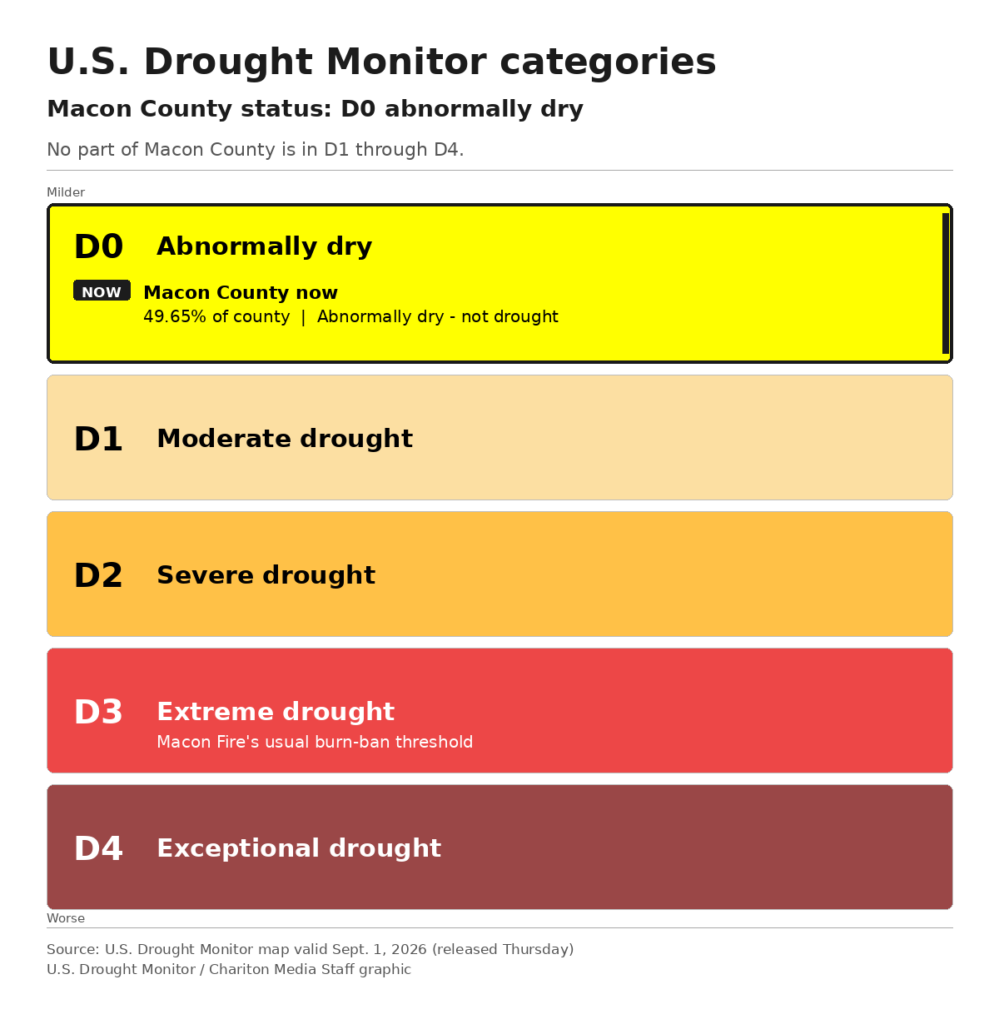
The U.S. Drought Monitor map released Thursday and valid Sept. 1 shows abnormally dry conditions, labeled D0, covering 49.65% of Macon County, up from 49.28% a week earlier. No part of the county is in moderate, severe, extreme, or exceptional drought. Abnormal dryness is not a drought category; moderate drought begins at D1.
The remaining 50.35% of the county has no drought or abnormal-dryness classification, compared with 50.72% a week earlier.
Austin said the Macon Fire Department typically implements a burn ban when conditions reach D3, extreme drought, and would consider additional burning restrictions at D2, severe drought.
He said residents should call the department at 660-385-6436 before burning to check restrictions and conditions. Within the city, only natural vegetation may be burned; household waste, construction materials, and other man-made materials are prohibited.
Fires in approved burn containers must be at least 15 feet from a structure. A burn pile 3 feet or less in diameter and 2 feet or less in height must be at least 25 feet from a structure. All other open burning must be at least 50 feet from any structure, Austin said.
Any outdoor fire must be attended while it burns, with extinguishing equipment ready, he said. The safest approach in dry weather is to avoid unnecessary outdoor burning and use caution with equipment that could spark in dry grass, Austin said.
The city compost site at the end of Blees Industrial Drive accepts yard waste as an alternative to burning, he said. If a fire gets out of control, call 911 immediately.
Gov. Mike Kehoe's statewide drought alert ran until Sept. 1 under Executive Order 26-09, according to the Missouri Department of Natural Resources. The department lists no later order.